
AQUARIUS stands for Advancing Quantitative Understanding and Assessment of hydrological Risks, Impacts and Uncertainty across Scales.
We investigate how hydrological extremes, including droughts and floods, have evolved over time and how they respond to climate change. We combine hydrological modelling with observations, climate simulations and Earth observation data to understand changes in water availability and extremes from catchment to global scales. Spanning from historical to future projections.
Our research includes:
- Past droughts and long-term hydroclimatic variability: putting recent extremes into a longer historical perspective. We combine hydroclimatic reconstructions and hydrological simulations to investigate how drought severity, persistence and spatial extent have varied over past centuries, and what makes recent events exceptional.
- Rapidly developing hydroclimatic extremes: investigating the onset and evolution of events such as flash droughts and heatwaves. We assess how their frequency, spatial extent and severity vary under present-day conditions and change with global warming. This research is led by PhD researcher Devvrat Yadav.
- Climate change and hydrological extremes: exploring how human-induced warming affects droughts and low river flows, and how regions shift between dry and wet conditions. By simulating how the same weather event would unfold in different climates, we assess the role of warming in shaping its hydrological consequences. This research is led by PhD researcher Ray Kettaren.
- Spatiotemporal drought dynamics: developing methods and datasets to identify, track and compare spatially connected drought events. We examine their extent, duration, movement and evolution in soil moisture and runoff. PhD researcher Vít Šťovíček contributes to this research.
- High-resolution hydrological modelling and Earth observation: investigating when finer spatial resolution improves the representation of water-cycle processes and hydrological extremes, and how satellite observations can support model calibration and evaluation. Building on contributions to the ESA-funded 4DHydro project, we examine model consistency across scales and the added value of high-resolution simulations.
- Model calibration, evaluation and uncertainty: improving how hydrological models represent the water cycle by evaluating river flow, soil moisture, evapotranspiration and water storage together. We investigate how parameter estimation, meteorological inputs and model structure affect the reliability of simulations and climate-impact assessments.
- Hydrological forecasting and early warning: exploring how hydrological models, weather forecasts and observations can help anticipate floods and droughts. We investigate how updating models with recent observations improves forecasts, and how predictive skill and uncertainty change with forecast lead time. This research is led by PhD researcher Chaitanya Raj.
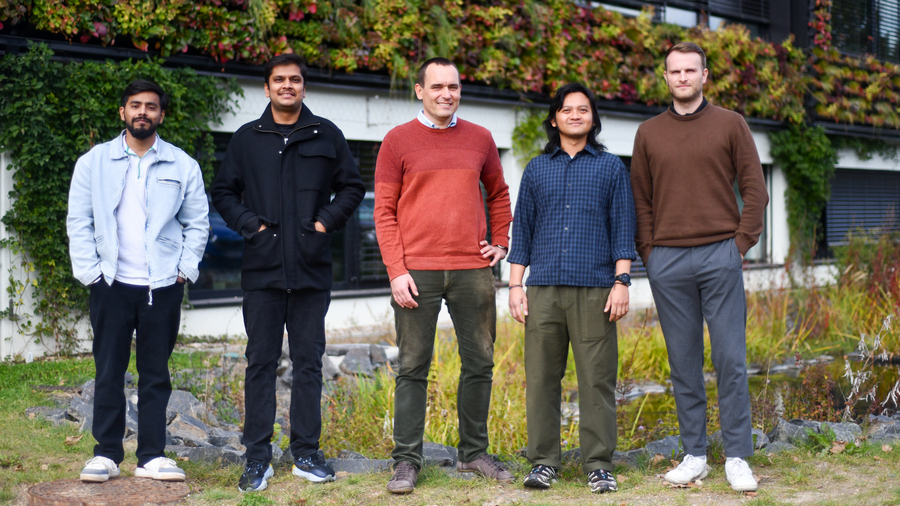
AQUARIUS is led by Oldrich (Olda) Rakovec at the Department of Water Resources and Environmental Modeling, Faculty of Environmental Sciences, Czech University of Life Sciences Prague. The lab forms part of the Hydrological and Climate Variability (HCV) leading research group (led by prof. Martin Hanel), and is supported through the Research Excellence in Environmental Sciences – REES programme.
Through national and international collaborations, we develop hydrological datasets, event catalogues and scientific assessments that support drought preparedness, climate adaptation and water management.