
How would the same drought or flood unfold in a cooler or warmer world? Our REES research combines climate storylines with hydrological modelling to examine how human-induced warming changes soil moisture, the magnitude and timing of high and low river flows, as well as the water availability across Europe. By keeping large-scale atmospheric circulation comparable across simulations, we investigate how warming affects the development, severity and duration of individual hydrological extremes.
We work with the climate-storyline team at the Alfred Wegener Institute (AWI) and colleagues at the Helmholtz Centre for Environmental Research (UFZ), connecting climate experiments with expertise in hydrological modelling and compound extremes. Building on these collaborations, we aim to explore how adaptation measures could reduce the impacts of extreme events and support water management in a changing climate. The REES programme supports this research and the development of the AQUARIUS lab at CZU.
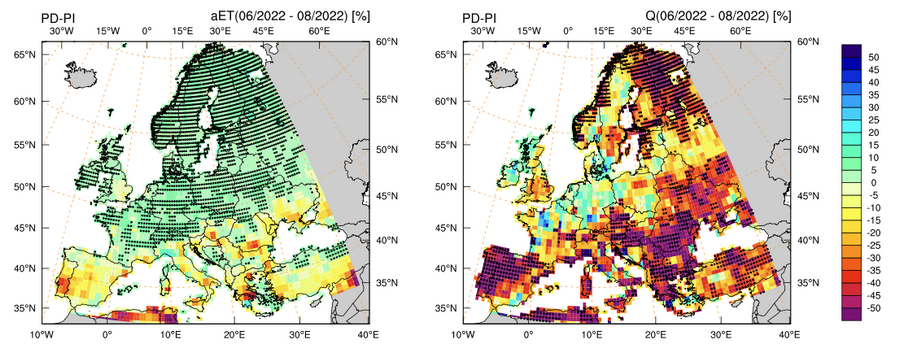
Figure caption: Spatial maps show the relative change [%] in actual evapotranspiration (left) and gridded runoff (right) simulated by mHM during the European summer (JJA) 2022 drought event. The figure shows the relative difference between present-day and pre-industrial climate conditions. Results are based on mHM simulations driven by storyline forcing derived from the AWI-CM-1-1-MR storyline simulations.