
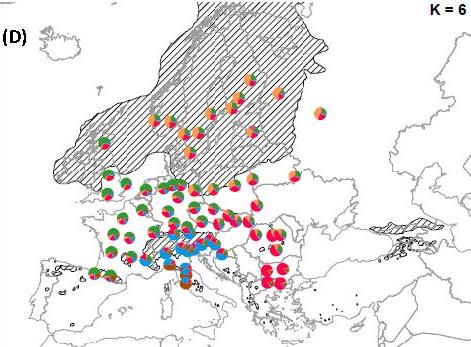
 Our molecular data in combination with reconstruction of postglacial migration of Alnus species based on paleoecological data showed that there were at least three main waves of expansion supported as the most likely by ABC analysis, i.e. (1) from the Iberian Peninsula to Western Europe and subsequently to British Isles, (2) from the Apennine Peninsula to the Alps and (3) from the Balkan Peninsula to the Carpathians following by expansion towards Northern European plains. This challenges the classical paradigm that most European populations originated from refugial areas in the Carpathians. It has been shown that colonizing lineages have met several times and formed secondary contact zones with unexpectedly high population genetic diversity in Central Europe and Scandinavia. On the contrary, limited genetic admixture in southern refugial areas of A. glutinosa renders rear-edge populations in the Mediterranean region more vulnerable to extinction due to climate change.
Havrdová A., Douda J., Krak K., Vít P., Hadincová V., Zákravský P. & Mandák B. (2015): Higher genetic diversity in recolonized areas than in refugia of Alnus glutinosa triggered by continent-wide lineage admixture. Molecular Ecology 24: 4759–4777.
Link: http://onlinelibrary.wiley.com/doi/10.1111/mec.13348/abstract