
The hydrological cycle and temperature have a complex relationship. Understanding this relationship is essential for socioeconomic property and policy making. The prevailing theory suggests the hydrological cycle intensifies as the temperature rises. However, the exact magnitude of the hydrological cycle response and its spatio-temporal response is still under investigation. Analyzing past hydroclimate changes can help us understand how the hydrological cycle reacts to temperature changes. Therefore, our study investigated the paleo hydrological cycle variability and how it relates to temperature shifts, specifically in warm and cold climates. The periods selected for investigation are the Mid-Miocene Climate Optimum (MMCO), the Eemian Interglacial (EI) Stage, the Last Glacial Maximum, the Heinrich and Dansgaard-Oeschger Events, the Bolling-Allerod, the Younger Dryas, the 8.2 ka event, the Medieval Climate Anomaly, and the Little Ice Age.
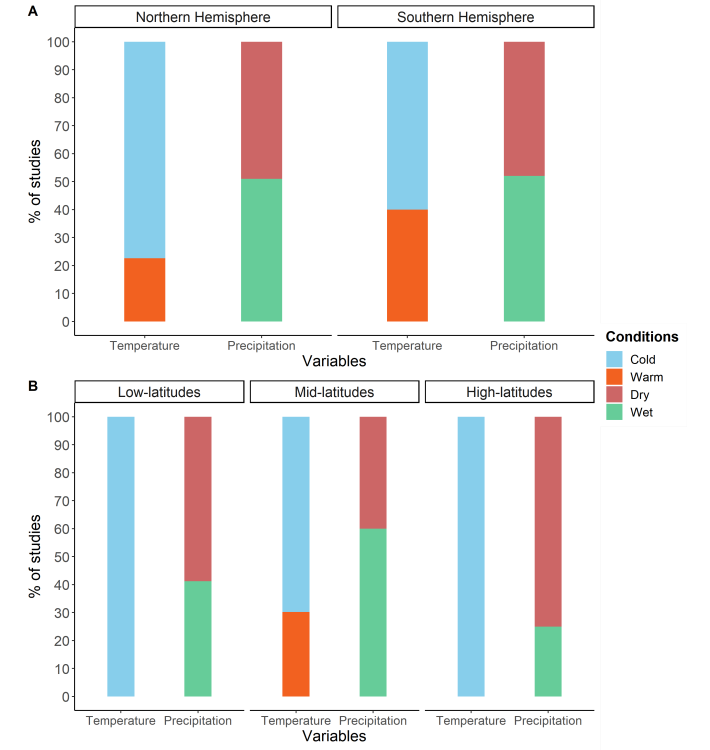
Fig. 1: Relationship of temperature and precipitation during the cold periods (LGM, Heinrich Events, Younger Dryas, 8.2 ka Event, and LIA). A) studies over different regions, B) studies over the different zones.
In general, the proxy records suggest that the hydrological cycle is intensified under warmer climate conditions and weakened over colder periods. However, the spatial signals are not uniform worldwide. For instance, during the MMCO and EI, the global temperature was higher than the pre-industrial time; some regions were wetter (northern Eurasia and Sahara Arabian desert), while others were more arid (Argentina, Bolivia, and Africa). Our outcomes report that the hypothesis ‘a warmer climate is a wetter climate’ could be considered a simplified pattern of regional changes due to warming in the atmosphere. The reason is that the water cycle response is spatiotemporally not similar. Further, investigating paleo hydroclimate changes, especially in the warm climate, could provide relevant insights into the present and future climate.
Read the whole article by Shailendra Pratap and Yannis Markonis at https://doi.org/10.1186/s40645-022-00489-0