
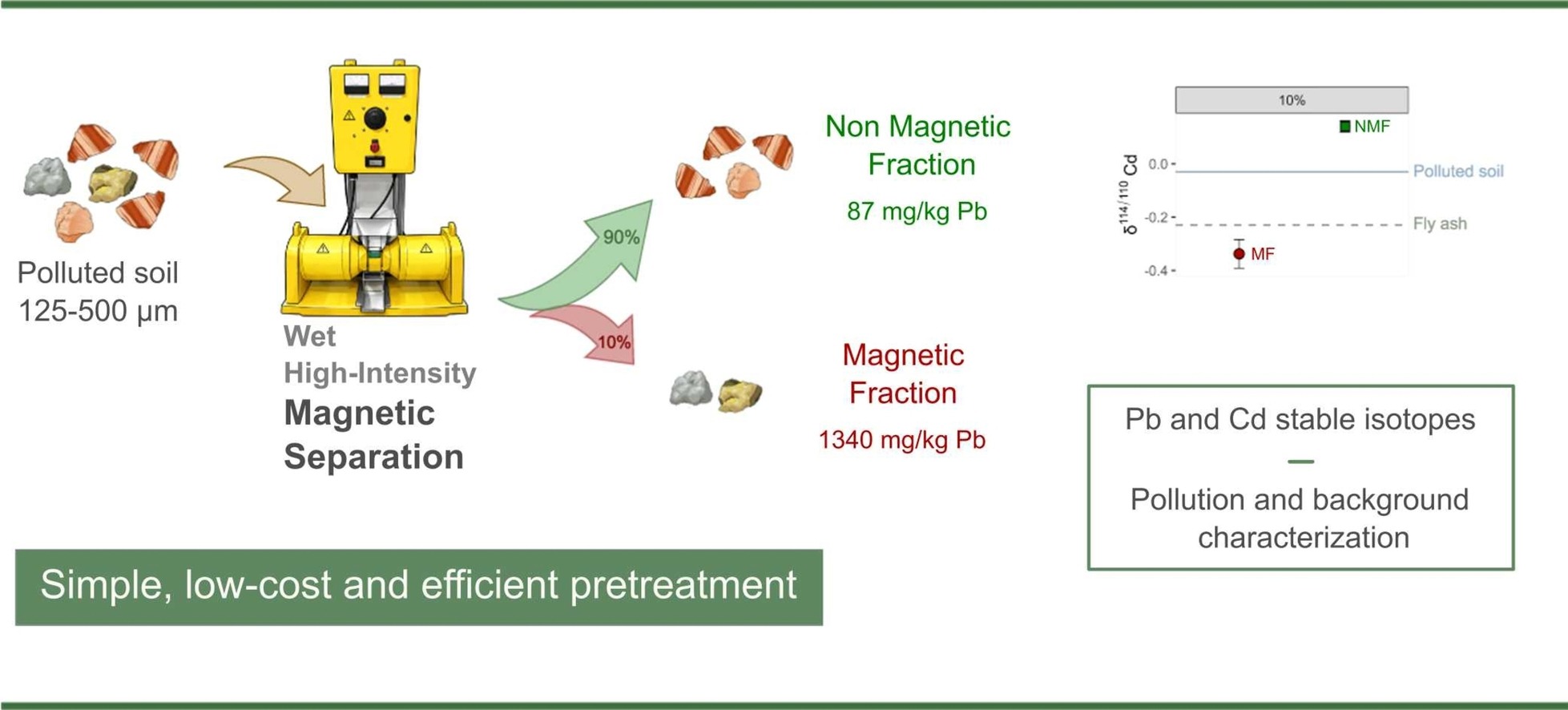
Understanding the origin of toxic metals in polluted soils is often challenging because natural geological inputs are mixed with long-term anthropogenic contamination. In our newly published study, we present an innovative approach that combines magnetic separation with stable isotope analysis of lead (Pb) and cadmium (Cd) to distinguish between geogenic and anthropogenic sources of contamination.
The method was tested at a site affected by historical smelting activities, where magnetic fractions showed isotopic signatures matching smelter emissions, while non-magnetic fractions reflected the natural geochemical background. Our results show that magnetic separation represents a simple, effective, and relatively low-cost pre-treatment that can significantly improve source identification in contaminated soils. The approach offers new opportunities for environmental monitoring, risk assessment, and remediation of legacy industrial pollution sites.
Astray B., Ratié G., Chrastný V., Komárek M., Berrezueta E., Baragano D., 2026. Magnetic separation coupled with Pb–Cd stable isotopes to unravel geochemical background in metal(loid)-polluted areas. Journal of Hazardous Materials 511, 142171. DOI: 10.1016/j.jhazmat.2026.142171
Read the paper here.