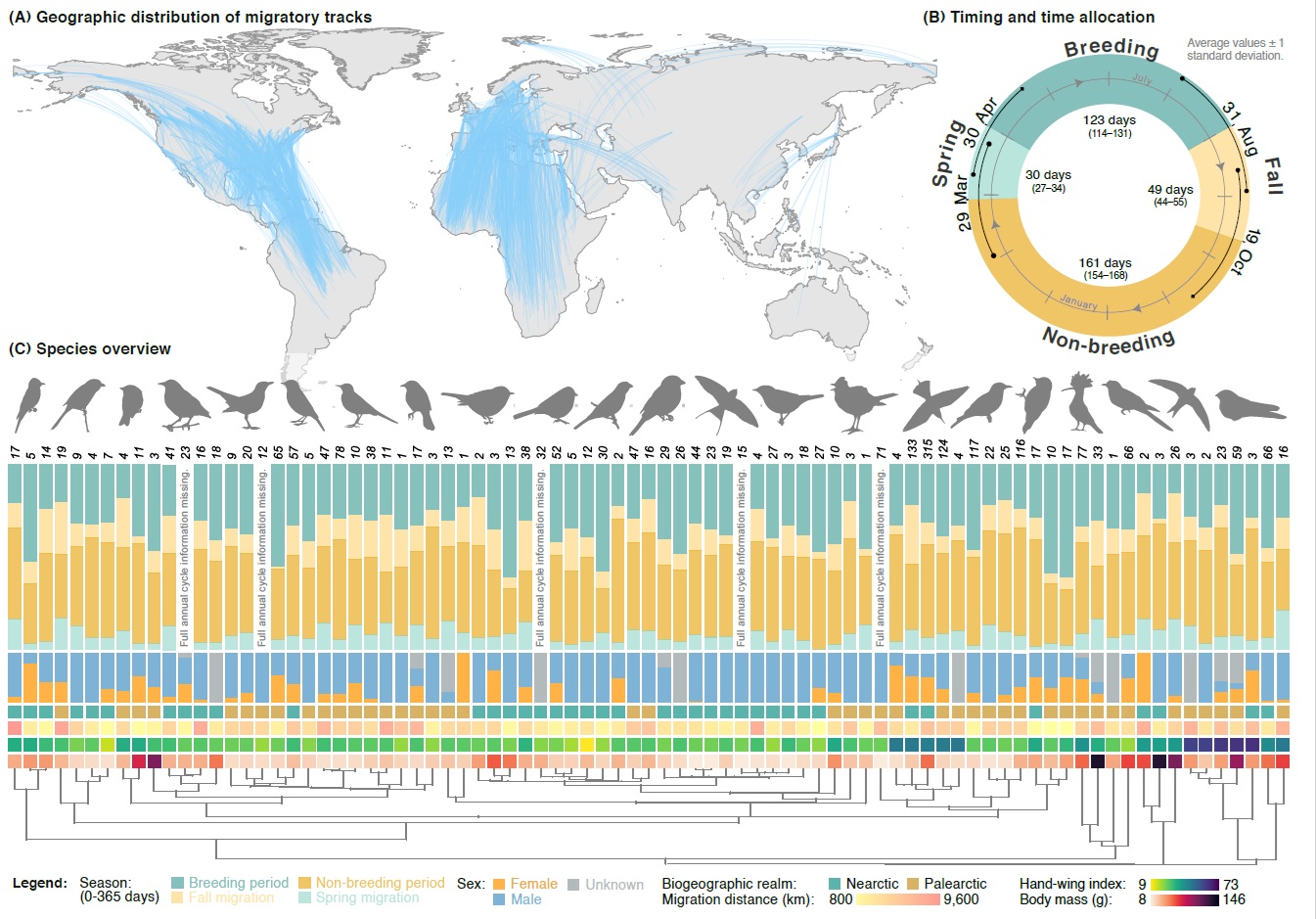
An international research team—including ornithologist Martin Bulla from FZP CZU—has just published a study in the Nature Ecology & Evolution journal examining the temporal links between the various phases of the annual cycle of migratory birds. By reconstructing the year-round migratory behavior of 2,324 individuals across 83 bird species, the researchers discovered a strong temporal connection throughout the migration process: from departure from breeding grounds and arrival at wintering grounds, to departure from wintering grounds and the eventual return to the breeding ones. As part of the study, the scientists compiled a unique global database of data from tracking devices. They found that while birds can compensate for some delays by traveling faster, this compensation is never complete.
"We observed a behavioral shift—specifically, birds spending less time in transit. However, the delay persists; birds that set off later also arrive later. This naturally raises the question of how this added stress might ultimately affect their fitness," says Martin Bulla, commenting on the findings.
The study confirms that the various phases of migration are not temporally independent; therefore, a change or disruption in conditions during one part of the year can have a ripple effect on other stages of the annual cycle. If environmental changes driven by e.g. climate change shift suitable conditions in breeding grounds, along migratory routes, or in wintering areas, birds possess a certain degree of flexibility; however, their ability to compensate for a temporal shift remains limited.
Citation:
Brlík, V., Procházka, P., Rushing, C.S. et al. Temporal links in avian migration schedules across the annual cycle. Nat Ecol Evol (2026). https://doi.org/10.1038/s41559-026-03208-w