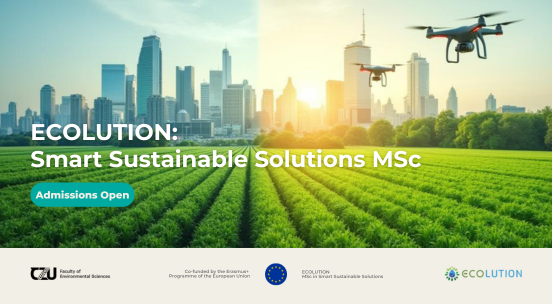
I completed my bachelor’s degree in Environmental Engineering at the Czech University of Life Sciences in Prague which gave me a strong foundation in understanding how natural and engineered systems interact. And I decided to continue building on that. My curiosity combined with a desire to work with cutting-edge sustainable technologies led me to search for a programme that would bridge engineering, innovation, and ecological thinking. That is precisely what I found in Ecolution (Smart Sustainable Solutions) at the Czech University of Life Sciences in Prague - a programme that brings policy, science, and technology under one roof and turns them into practice. It is a brand new program and I am honoured to be one of the first students.
A programme built for the future of sustainability
What makes Ecolution genuinely stand out is its interdisciplinary nature. It approaches sustainability from multiple angles - ecology, technology, engineering, circular economy, digital tools, and real-world environmental management.
The curriculum of Smart Sustainable Solutions Master’s programme spans an impressive range of topics. On the theoretical side, courses such as Circular Economy Management, Environmental Policy & Planning, and Hydrological and Climate Variability provide the essential scientific and conceptual background needed to understand today’s environmental challenges. We dive deep into topics like resource efficiency, climate dynamics, and how ecosystem services can be integrated into policy and planning. On the practical side, the programme covers technology-focused subjects such as Remote Sensing & Wireless Sensor Networks, IoT Platforms & Systems, Geospatial Data Sciences, etc. These courses will give students hands-on experience with the digital tools driving the modern “green transition”
These skills are not just useful, they are essential. Understanding hydrological processes is important, but being able to design real-time monitoring systems, work with large environmental datasets, or build sensor networks is what allows us to solve problems at scale. This blend of ecological thinking and technical ability is what makes Ecolution a programme aimed at the future.
A flexible part-time format - but still academically intensive
One of the first things people ask me about Ecolution is: “How do you manage studying part-time?” And my answer is always: carefully.
Although the programme is officially part-time, it is definitely not “easier” or less demanding. The reason the structure works is because the programme is designed for international mobility and collaboration with partner universities in Spain, Greece, Denmark, and Malta. Students attend concentrated blocks of lectures, each lasting 3 weeks, introductory sessions, and consultations, while a lot of the studying, project work, and data processing happens independently.
This structure is perfect for those balancing work, internships, or another degree (which many students in the programme do). But it also requires discipline. The course load per semester is still quite high, and the content is dense. You won’t find people skipping classes or slacking through assessments. Instead, you’ll find us analysing environmental datasets late in the evening, debugging code for sensor calibration, or preparing for oral exams on hydro-climatic processes.
I enjoy this independence. It pushes me to take responsibility for my learning and gives me freedom to explore topics more deeply. When we meet for consultations, discussions are rich, technical, and directly connected to real problems. You can bring your questions, your own data, or your doubts, and you get guidance not only from lecturers at CZU but also from international experts teaching in the programme.
Learning from experts across Europe
Another unique feature of Ecolution is the strong involvement of international institutions. Courses are co-taught by specialists from various countries.
This diversity enriches the learning experience in a way traditional programmes simply cannot. Each teacher brings a different perspective: from Mediterranean hydro-climate systems to Northern European soil modelling or Spanish sensor innovation.
Working with such a broad network of academics and practitioners gives us insights into how environmental systems differ across regions and how sustainability challenges must be addressed globally, not locally.
Real-world experience through industrial practice
For me, the highlight of the programme is the Industrial Practice, a mandatory summer internship students must complete after their first year. This is not just a checkbox - it is a core component of the degree and for the thesis preparation.
As one of the first students of Ecolution, I find this especially exciting. The internship is an opportunity to apply newly gained knowledge in real projects, whether in environmental monitoring, ecological restoration, circular economy planning, or sustainable engineering. It’s a chance to step into the professional world with strong guidance and university support.
Given the strong network of international partners, we have opportunities to complete internships not only in the Czech Republic but also across Europe. For anyone trying to build a career in environmental sciences, this kind of practical experience is invaluable.
Personally, I see industrial practice as the perfect bridge between academia and professional life. It is a chance to validate what I’ve learned, learn even more, build contacts, and hopefully open doors for future employment in the field.
Why Ecolution was the right choice for me
Ecolution brings theory and innovative environmental technologies relevant to the rapidly evolving sustainable landscape.
I now study subjects that genuinely excite me. I work with tools and methods that feel meaningful for my future career. I learn from experts who inspire me, and I am part of a new generation of students shaping a programme that has huge potential.
Most importantly, I feel that everything I learn has a purpose. Whether it’s understanding hydrological variability, analysing remote-sensing data, building an IoT monitoring system, or evaluating environmental risks - each piece connects to the bigger goal of creating smarter, more sustainable solutions for our planet.
And that is why I am proud to call CZU not just the university where I earned my bachelor’s degree, but also my alma mater - a place where my journey in environmental sciences truly is evolving.