
A new study published in the Journal of Environmental Chemical Engineering explores the effect of nano zero-valent iron (nZVI) on Cd behaviour in contaminated soils. Using fresh and aged nZVI together with the Cd-hyperaccumulator Noccaea caerulescens, the research reveals how different soil properties and nanoparticle ageing shape Cd uptake, mobility, and isotope patterns. In the alkaline Arenosol, aged nZVI reduced Cd bioavailability by 68 % due to iron-oxide formation, limiting Cd from entering plant roots. In contrast, in the acidic Fluvisol with high organic matter, plants strongly lowered Cd in pore water but maintained stable isotope patterns, indicating different controls on Cd movement from roots to shoots.
These findings highlight how combining chemical stabilisation with phytoextraction can enhance remediation but also show that strategies must be tailored to specific soil conditions.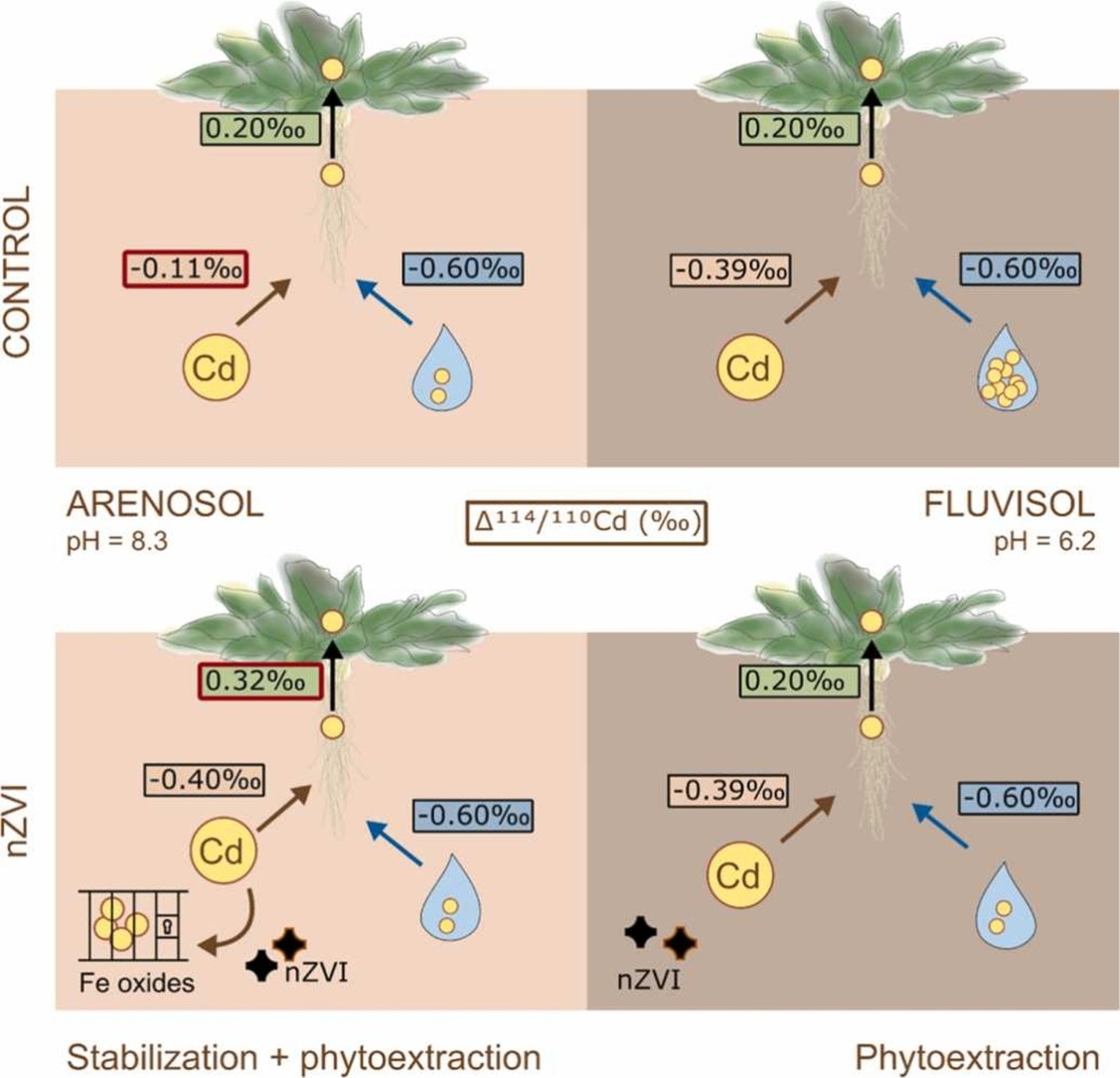
Chrastný V., Baragano D., Ratié G., Astray B., Šípková A., Böserle Hudcová B., Vítková M., Komárek M., 2025. The effect of fresh and aged nZVI on Cd uptake and translocation by Noccaea plant in two contrasting soils from industrial areas (Spain and the Czech Republic). Journal of Environmental Chemical Engineering 13, 120522. DOI: 10.1016/j.jece.2025.120522
Read the paper here.