
A 2021–2024 study examined seasonal changes in radon release from former uranium mine dumps No. 15 and No. 4 in the Příbram area. Using aerial and field ADER measurements, UAV-based hot-spot detection, grab air sampling, and continuous monitoring of Radon Activity Concentration (RAC), the team assessed how weather conditions influence radon transport. Analysis of long-term meteorological data (2005–2023) identified 890 nights, i.e., about 47 per year, with conditions favourable for radon accumulation and movement. During these periods, elevated radon levels were recorded, reaching several kBq/m3, with maxima up to 27 kBq/m3. The integrated approach provides a clearer understanding of radon dispersion and supports improved mitigation strategies for nearby communities. 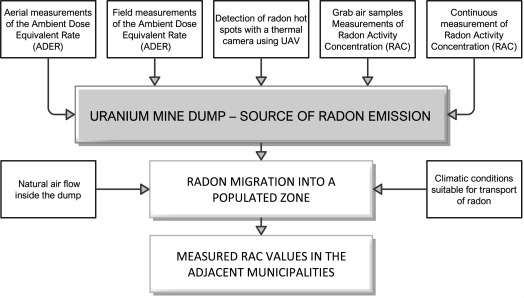
Adam T., Otáhal P., Jurda M., Komárek M., 2025. Monitoring the changing levels of radon emanation from former uranium mine dumps in different seasons and their effect on the surrounding atmosphere. Journal of Environmental Radioactivity 283, 107638. DOI: 10.1016/j.jenvrad.2025.107638
Read the paper here.