
Our team has introduced an innovative modelling framework that significantly improves the prediction of zinc and lead transport in saturated soils. By integrating batch and dynamic column experiments with reactive transport modelling in HYDRUS-1D, the study evaluates how biochar, amorphous manganese oxide, and their mixture influence metal retention. Results confirmed that batch tests tend to overestimate amendment performance, while column experiments revealed more realistic sorption behaviour, especially for the BCH + AMO mixture. To bridge this gap, the researchers developed a nonlinear regression and machine-learning-based conversion formula allowing batch-derived Freundlich parameters to be translated into values suitable for dynamic flow conditions. This approach reduces the need for resource-intensive column testing while maintaining accuracy. Validated in flood-prone soil, the framework shows strong potential for applications such as constructed wetlands and systems with stable pH and redox conditions.
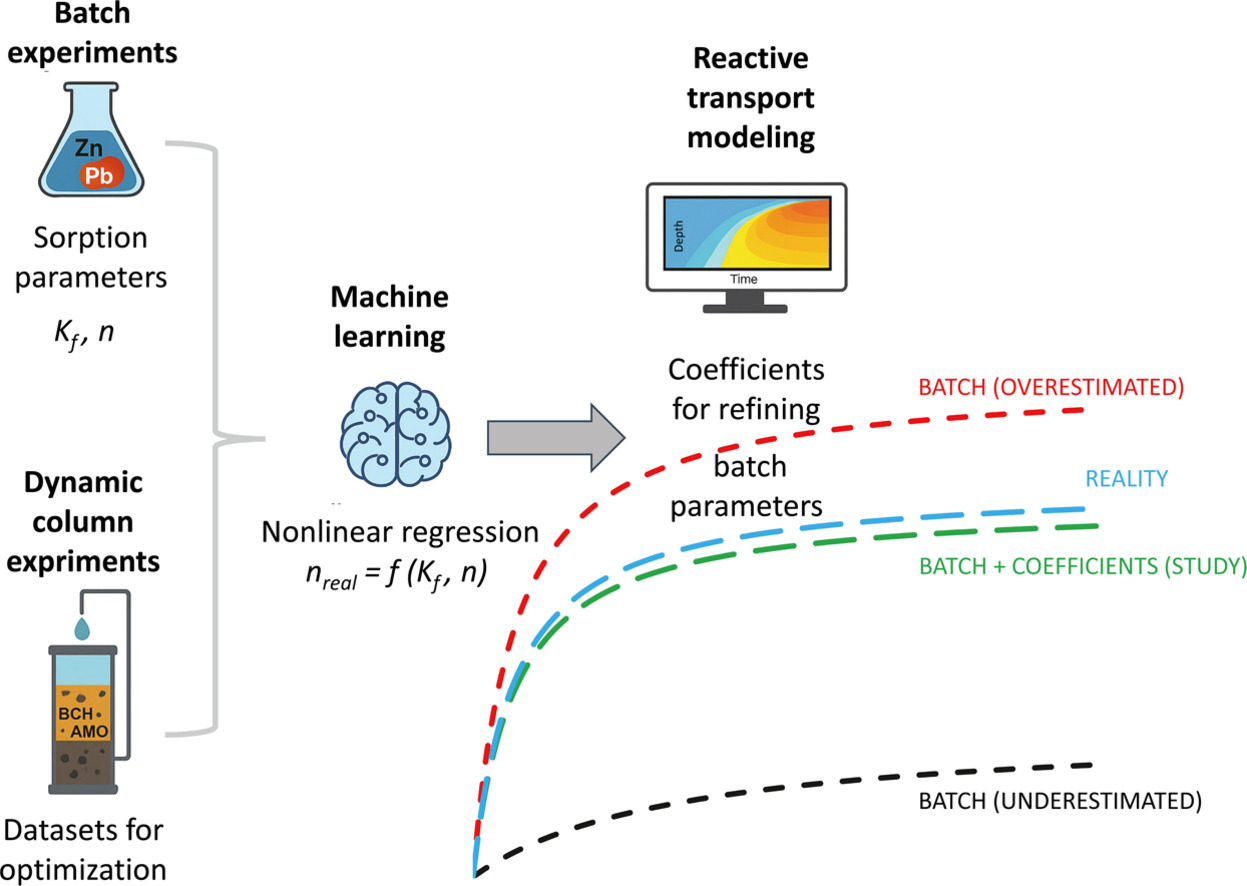 Ouředníček P., Böserle Hudcová B., Jacques D., Kodešová R., Trakal L., 2025. Advanced modeling of Pb and Zn reactive transport using HYDRUS-1D to refine metal sorption and leaching under dynamic conditions. Chemical Engineering Journal Advances 24, 100909. DOI: 10.1016/j.ceja.2025.100909
Read the paper here.